


I was in my late twenties when I realized I was religious. That may sound funny, since I’ve always been an observant Jew, but I wasn’t always cognizant of what this meant about me. The realization I came to was not properly a spiritual experience or a divine calling, but an introspective moment when I suddenly came to terms with the texture of my religious observance and where it fit in my life.
Let me clarify where I was coming from and what I believed up until that moment, so you can stand in my shoes while I describe it.
I went to an Orthodox Jewish high school, and my Talmud teacher came from a very idiosyncratic yeshiva (religious seminary), which held to what one might call a medieval rationalist viewpoint, that proper religion is an inevitable and provable system of axioms.
In the Middle Ages, scholars such as Al-Farabi (Muslim), Maimonides (Jewish), and Aquinas (Christian) all wrote long treatises arguing that, when approached philosophically, religious belief was fully logical and its tenets demonstrable. While such a perspective may sound quaint in our modern scientific world, like attending a medieval festival with jousting and drinking songs, the yeshiva I attended was deadly serious about maintaining this view.
We were told: “Judaism is not based on faith, but reason. We are a rational system, in line with modern findings.” In keeping with this self-image, the yeshiva peppered its religious instruction with modern rationalist classics, idolizing Einstein, Darwin, Freud, Hume, and Russel. And yet, at its core, this claim was chimerical.
Like most yeshivot, we spent our time studying ancient religious texts, whether about self- improvement or just working through technical debates about the finer points of Jewish law in the Talmud. It goes without saying that we practiced all the Jewish laws with great precision and care.
Nothing is wrong with this, of course; I still live this way, more or less. But we were dishonest in not owning our religious impulses, the denial of which is eerily reminiscent of how many people will pretend not to have strong sexual desires, preferring to mask things in euphemism or prevarication.
Ever since humanity ate from the tree of knowledge—metaphorically speaking—we have been plagued with shame over our greatest needs, while knowing full well that we have them and that everyone else has the same ones. While this is primarily true of sex, it is often true of our religious impulse as well, which may, perhaps, be better characterized as the impulse to infuse our life with meaning and to feel part of something larger.
I can still remember that feeling of repressed shame over our religiosity so prevalent in the yeshiva. On one hand, our entire lives orbited around studying holy books and perfecting our religious practices. On the other hand, we fancied ourselves a collection of Orthodox Jewish Bertrand Russells. We almost never sang the classic Jewish songs, preferring rock music, we dressed like modern people, without special garb, and we acted as if we were something entirely different than other Orthodox Jews of our ilk.
It was sometime in the mid-2,000s, during the Shavuot prayer service—the festival celebrating the giving of the Torah—when I realized I was lying to myself (and others), pretending my ritual behavior was some kind of rationalistic necessity instead of an expression of a deeper need for meaning and belonging.
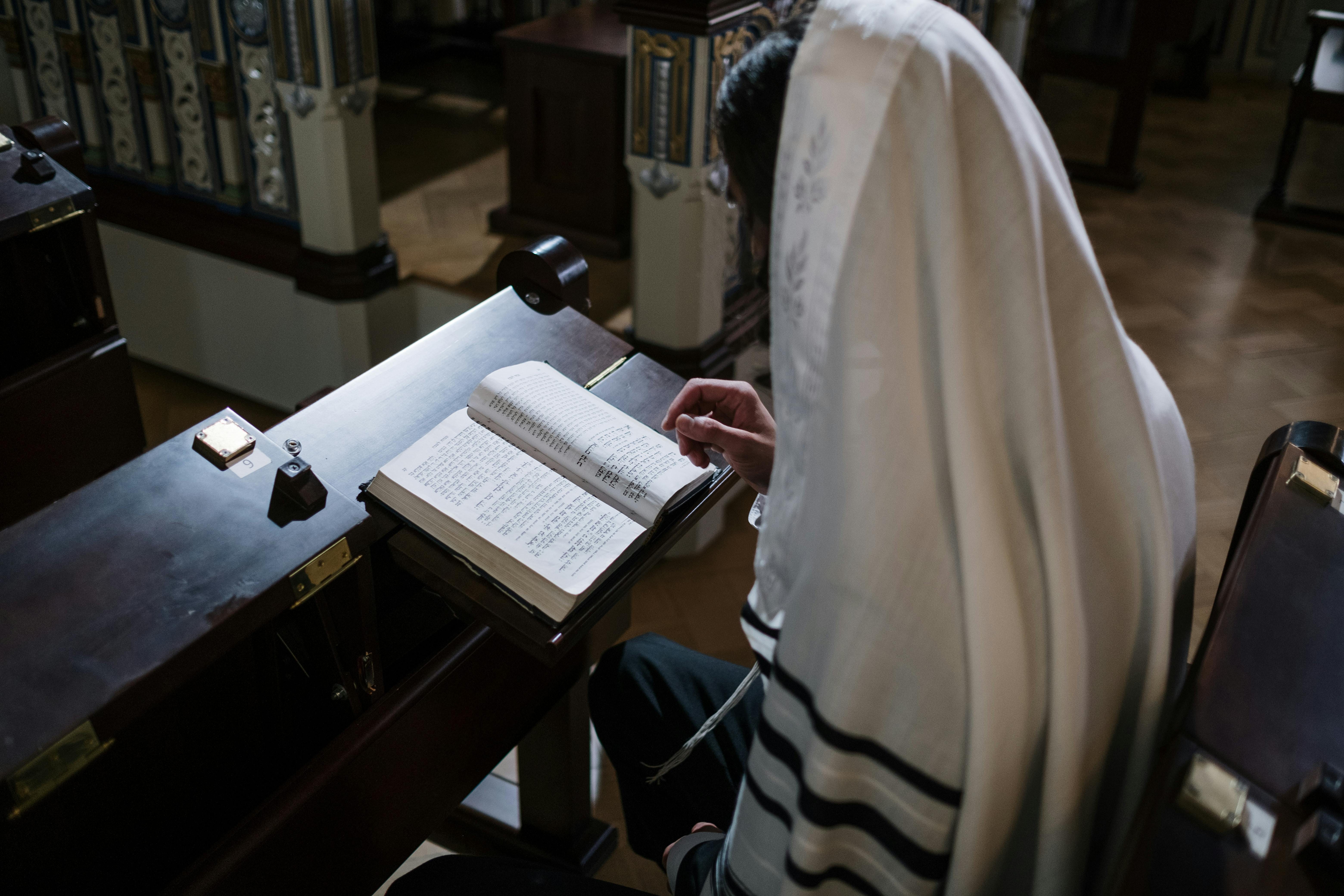
I was attending, as I always did in those days, the vatikin minyan (early morning prayer quorum), which adjusts its start-time every day to ensure that we reach the Amidah—the main prayer—exactly at sunrise (henetz hachamah). As we began the silent devotion, I put my talit (prayer shawl) over my head, locked my feet together, placed both hands upon my heart, and bowed.
If you have never stood this way, I can assure you, it is quite uncomfortable.
Why the shawl on my head? The Talmud says that one always covers one’s head as a sign of respect. This may be true for many cultures, especially in the past, but if I were to speak in a public forum today, I would certainly not put a shawl on my head. The behavior is a ritual act.
The feet together is even more niche. The prophet Ezekiel, in his vision of the divine chariot, says that the angels have one straight (i.e., knee-less) leg. So when we pray, we are trying to stand like angels.
The height of this practice comes in the kedusha “holiness” prayer, which contains several lines from the Bible which are direct quotes from the angels. When we say these words, we push our bodies up onto our tippy toes, to mimic how the angels move as they speak. While I’m sure all this has deep symbolic significance, understanding it formed no part of my practice. It was simply what one does when reciting these prayers.
As I was hopping on my toes at 5:30am that Shavuot morning, talit on head, declaring God’s holiness, I suddenly said to myself: “Who on earth do I think I’m fooling? This is an expression of religiosity not rationality.” Then I thought, “You know what? I’m fine with that. Happy even. It’s time to embrace who I’ve always been.”