


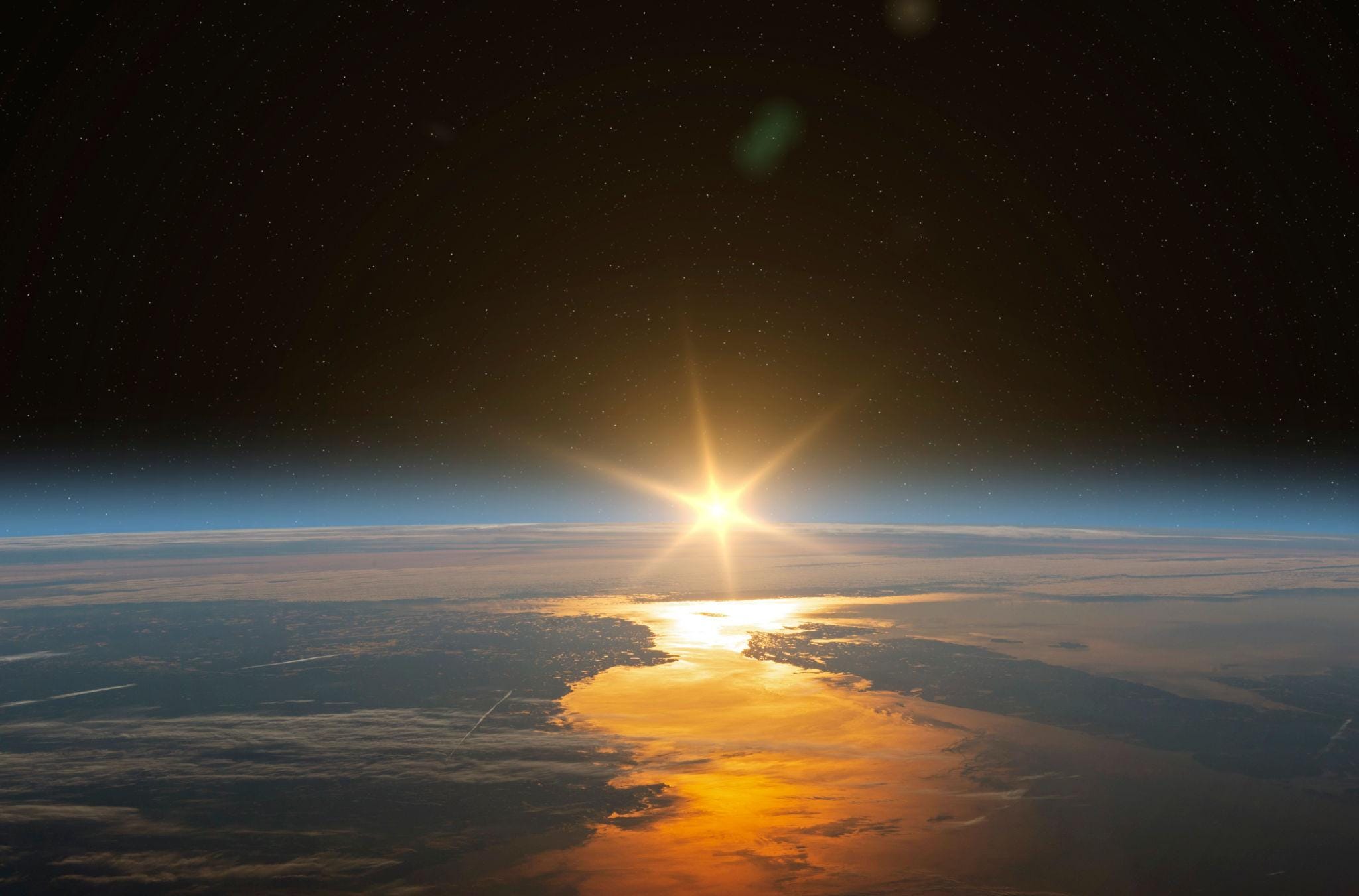
“Sunsets are beautiful” is a statement so obvious, it borders on the trite. And yet it’s an observation I more often than not forget.
The other night, I was taking a walk with my girlfriend at the end of a long workday, and as we turned down a hilly road, she stopped to watch the sun setting. Though we were looking right at it, I didn’t really notice, so she grabbed hold of my arm to stop me from continuing the walk and said: “I want to watch the sun go down.” The request was no surprise; she has always loved sunsets, and the experience of watching them inspires some of her poetry.
So we stood and watched the slow disappearance of the glowing ball under the horizon, as we had done on the beach only a few weeks before. “Can you see how the sky changes color above the clouds where the sun is going down?” she asked me, trying to help me connect to the experience. That specific question was not merely rhetorical, since I am colorblind and she wanted to know if I could discern what she was seeing, but the orange light over the purple cloud was visible even to me.
As the seconds passed, we gazed in silence, each lost in the experience or, at least, in our own thoughts. Of course, I don’t know what she—or anyone other than me—is thinking when watching a sunset. Perhaps the best approach is not to think about anything and just be present, though that is often easier said than done. I’ve been working on this kind of presence for a few years now, and, every once in a while, I succeed; this time, I did not.
Instead, my mind wandered to the meaning of sunset. Certainly, the phenomenon looks like the sun is traveling down below the horizon, but, scientifically speaking, as we all know, what is happening is quite different: the earth is constantly spinning, and, by definition, not every part of its sphere can face the sun at the same time. That evening, my part of the globe was about to be facing far enough in the other direction that we would not be able to see the sun again for hours, until the next morning. I stared hard, trying to picture this, but for the life of me, I could not.
Why is it that I can’t experience the movement that I know to be real? Why should my subjective sense of self as stationary be so much stronger than my intellectual knowledge of the world as in motion? As the sun disappeared below the horizon, this niggling question troubled me.
I’m not unique in this struggle to break out of my subjective experience. What does it say about humanity that we cannot easily envision the world we live in as it is?
This problem goes well beyond sunsets. We modern, scientific humans have the same problem picturing ourselves as mostly empty space held together by a collection of subatomic particles, even though we all learned about protons, electrons, and quarks this in junior high school. Nor can we easily picture the short amount of time we live on this earth in contrast to the billions of years the sun has been shining on our planet, even though most of us can spit out the numbers.
It would seem that it is difficult for beings wired as we are to make sense of the universe as is. This is why religion is such a core aspect of human activity.
To live in this world, we need to bridge the gap between the real and the perceived. The real is too cold, too impersonal, too granular. But the perceived is illusory and elusive. What is our place in this complex world? What makes the collection of atoms that is me different than the collection of atoms that is my child, or partner, or parent? What can I do to give my short time as this collection meaning and significance?
There is likely no objective answer to this question, but the world’s religious systems have been working for centuries to offer paths towards our finding answers that work for us. Sometimes, the suggested path is through chants, rituals, or other complex rites—as anyone embedded in such a system (as I am) knows. Yet other times, the path towards such a feeling can be a very simple experience of presence during a beautiful moment, such as when one is standing with a loved one, or by yourself, while watching a sunset.
Lovely seam-sewing.
Well expressed